

Antibody characterization is often described as a collection of analytical tests. For non-IgG antibodies, however, it is more useful to think of characterization as a decision-making framework.
IgA, IgM, IgE, IgY, and engineered non-IgG formats can differ substantially from conventional IgG molecules in molecular size, oligomeric organization, chain assembly, glycosylation, purification behavior, stability, and biological activity. These differences mean that an assay package developed primarily for IgG cannot always be transferred directly to a non-IgG program.
This challenge becomes particularly important for multimeric antibodies. IgA may occur in monomeric, dimeric, or secretory forms, while IgM can assemble into large pentameric and hexameric structures. Structural studies have shown that the J chain contributes directly to the organization of polymeric IgA and IgM, making correct assembly part of the molecule’s identity rather than simply a secondary quality attribute.
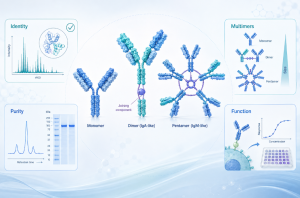
A useful non-IgG antibody characterization checklist should therefore answer four connected questions:
| Characterization Area | Key Question | Typical Analytical Goal |
|---|---|---|
| Identity | Is this the intended molecule? | Confirm chains, molecular mass, sequence-related features, and expected assembly |
| Purity | What else is present? | Detect fragments, aggregates, impurities, and product-related variants |
| Multimers | Is the antibody assembled correctly? | Determine monomer, dimer, pentamer, hexamer, aggregate, or other oligomeric populations |
| Function | Does the characterized molecule perform as expected? | Measure antigen binding, potency, receptor interactions, or relevant biological activity |
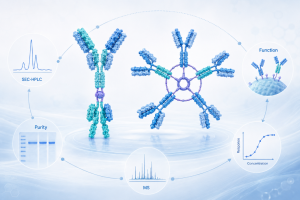
The most informative strategy is not to evaluate these four categories independently. Identity, purity, multimer distribution, and function should be interpreted together.
Why Non-IgG Antibody Characterization Requires a Different Checklist
IgG characterization workflows benefit from decades of standardized development experience. Non-IgG molecules introduce additional variables.
For example, the molecular organization of polymeric IgA depends on the heavy-chain tailpieces and J chain. Cryo-electron microscopy studies of dimeric and secretory IgA have demonstrated that two IgA units form an organized assembly around the J chain, while secretory IgA contains an additional secretory component.
IgM presents an even more obvious multimer challenge. Recombinant IgM preparations may contain different oligomeric populations, and the molecule’s large size makes production, purification, and biophysical analysis more complicated than for conventional IgG. Experimental characterization of recombinant IgM has used complementary methods including analytical ultracentrifugation, SEC-MALS, mass photometry, and electron microscopy to distinguish pentameric and hexameric states.
These examples illustrate an important principle: a single “purity percentage” does not fully describe a non-IgG antibody.
A sample may look relatively clean on an electrophoretic assay while still containing an undesirable distribution of assembled species. Conversely, a large peak in a size-based assay may represent the intended multimer rather than an aggregate. Characterization must therefore define what the correct molecular state should be before interpreting the data.
Checklist Item 1: Confirm Molecular Identity
The first question is simple: Did the production process generate the intended antibody?
For a conventional antibody, identity testing generally considers heavy and light chains, intact molecular mass, and sequence-related properties. For non-IgG formats, the definition of identity may also include additional assembly components.
Mass spectrometry can provide intact-mass information, while electrophoretic methods can help confirm expected heavy- and light-chain patterns. Creative Biolabs’ non-IgG characterization platform, for example, includes intact mass determination, N- and C-terminal analysis, HPLC, SDS-PAGE, Western blotting, and other analytical approaches for antibody characterization.
The expected molecular architecture should be defined before testing begins.
For a monomeric IgA construct, detecting a large dimer population may indicate unintended assembly. For a deliberately produced dimeric IgA, however, the dimer is the desired product. Similarly, an IgM project may specifically aim for a J-chain-containing pentamer. In this situation, confirming only the identities of the individual polypeptide chains would be insufficient.
Identity testing should therefore address both primary molecular identity and assembly identity.
This distinction becomes particularly valuable during process optimization. If a production change modifies the relative abundance of correctly assembled and incorrectly assembled species without changing the underlying amino acid sequence, sequence confirmation alone will not reveal the problem.
Glycosylation and other post-translational features may also contribute to molecular heterogeneity. These attributes do not necessarily indicate that an antibody has the wrong identity, but they may influence analytical profiles, stability, receptor interactions, and subsequent biological behavior. Characterization should consequently establish an expected profile rather than searching for an unrealistic single homogeneous molecular species.
Checklist Item 2: Evaluate Purity Beyond a Single Number
Purity testing asks a different question: What is present besides the desired antibody species?
Potential product-related impurities can include fragments, incomplete assemblies, higher-order aggregates, or alternative oligomeric states. Process-related impurities may arise from the expression and purification workflow.
SDS-PAGE and related electrophoretic approaches remain useful because they show chain-level patterns and can reveal fragmentation or unexpected species. HPLC-based analysis adds another dimension by separating molecular populations according to physicochemical properties. These methods are already used within non-IgG antibody characterization workflows.
For non-IgG molecules, however, purity and oligomeric state should not be confused.
Consider an IgM preparation containing a major pentamer peak and a smaller hexamer population. Both species may contain correctly formed immunoglobulin chains. Whether the hexamer should be classified as a desired form, product variant, or impurity depends on the intended product profile.
The same issue can arise with IgA monomers and dimers.
This is why chromatographic purity results should always be interpreted against a predefined target molecular state. A result such as “95% main peak” has limited meaning unless the main peak has been identified and its molecular composition understood.
Purification conditions can further affect these profiles. Creative Biolabs notes that non-IgG purification strategies often differ by isotype; for example, size-exclusion and ion-exchange approaches may be particularly relevant to IgM because of its large polymeric architecture.
A strong characterization workflow therefore connects purification analytics with structural characterization instead of treating purification and characterization as separate activities.
Checklist Item 3: Characterize Multimers with Orthogonal Methods
For many non-IgG programs, multimer characterization is the central analytical challenge.
Why?
Because an oligomeric antibody can occupy a size range in which different populations may overlap, and molecular shape can influence how a molecule behaves in a chromatographic system. An assay that separates molecules according to apparent hydrodynamic size does not necessarily provide an unambiguous molecular mass.
For this reason, orthogonal analysis is valuable.
Size-exclusion chromatography can provide a practical first view of the distribution of high- and low-molecular-weight populations. When SEC is coupled with multi-angle light scattering, the analysis can provide molecular-mass information that helps determine whether a chromatographic peak corresponds to an expected multimer or an unexpected higher-order species.
The value of combining techniques has been demonstrated directly for recombinant IgM. One study characterized pentameric and hexameric IgM using analytical ultracentrifugation, SEC coupled with multi-angle light scattering, mass photometry, and transmission electron microscopy. The different methods provided complementary information on polymer distribution and sample quality.
This principle is more important than any particular instrument: do not assign a multimer solely from one analytical signal when the assignment matters to downstream decisions.
For IgM, characterization may need to distinguish pentamers, hexamers, incomplete assemblies, and higher-order aggregates. Structural research confirms that pentameric and hexameric IgM can adopt distinct organized architectures and that oligomeric state is closely connected to biological behavior.
For IgA, the question may instead be whether the preparation contains the intended monomeric or dimeric population and, where relevant, whether additional components required for secretory IgA are properly incorporated. Structural studies demonstrate that dimeric IgA is not simply two independent monomers that happen to associate; the J chain participates directly in its organized structure.
Multimer analysis should also be repeated after important manufacturing or handling changes. Freeze-thaw cycles, concentration steps, formulation changes, storage, and purification conditions can potentially shift molecular populations. A baseline multimer profile therefore becomes a useful reference for later stability and developability studies.
Checklist Item 4: Connect Structural Quality to Function
An antibody can have the expected sequence and still fail biologically.
That is why the final part of the characterization checklist must answer: Does the molecule perform its intended function?
Binding assays can evaluate antigen recognition, relative affinity, specificity, cross-reactivity, and concentration-response behavior. Depending on the research objective, ELISA, affinity-ranking methods, epitope analysis, EC50 or IC50 measurements, and cell-based assays can provide complementary functional information. These types of assays are included among established non-IgG characterization approaches.
For multimeric antibodies, functional testing deserves particular attention because multivalency can affect apparent binding behavior.
An IgM molecule can engage multiple antigen sites through multiple Fab arms. Consequently, a bulk binding signal may reflect avidity as well as the intrinsic affinity of individual antigen-binding sites. Two preparations containing different multimer distributions may therefore generate different functional responses even if they originated from the same antibody sequence.
Functional characterization should consequently be performed using samples whose structural composition is already understood.
The relationship between IgM architecture and function is especially evident in complement activation. Structural studies have shown how antigen-bound pentameric and hexameric IgM can organize Fc regions to support C1 engagement and activation of the classical complement pathway.
This illustrates why “function” should not be evaluated as an isolated final assay. If one batch produces lower activity than another, the investigation should return to the identity, purity, and multimer data. A change in functional activity may be caused by altered assembly, aggregation, fragmentation, or another structural attribute rather than a loss of antigen recognition itself.
Building a Stage-Appropriate Characterization Strategy
Not every project requires every analytical method at every stage.
Early discovery studies may need enough information to confirm molecular identity, determine whether the correct multimer is being produced, and establish that the antibody retains target binding. Once a candidate progresses into production optimization, greater attention can be given to purity, assembly consistency, aggregation, and batch-to-batch comparability.
Later studies can expand toward stability, developability, mechanism-relevant functional assays, and PK/PD evaluation.
The important point is that the characterization strategy should evolve with the questions being asked.
During expression screening, for example, the key question may be, “Which condition gives the highest proportion of correctly assembled product?” During purification development, it may become, “Can the desired multimer be separated from incomplete or aggregated species?” During functional evaluation, the question may be, “Does the purified molecular population retain the required binding and biological activity?”
Thinking in this way prevents characterization from becoming a box-checking exercise.
It also creates more actionable data. If a candidate fails one part of the checklist, researchers can identify whether the next step should involve production optimization, purification improvement, molecular engineering, formulation work, or additional functional investigation.
Common Interpretation Pitfalls
One frequent mistake is assuming that the largest molecular species is automatically an aggregate. That assumption may be reasonable for a conventional monomeric IgG, but it can be misleading for intentionally multimeric antibodies.
Another mistake is treating the main SEC peak as proof of correct assembly. SEC is valuable, but molecular size and molecular identity are not identical concepts. Orthogonal techniques can help verify whether the main species has the expected molecular mass and architecture.
A third problem is comparing functional activity between samples without considering differences in multimer distribution. If one IgM preparation contains a different proportion of pentamers and hexamers than another, differences in apparent activity may reflect structural composition.
Finally, characterization is sometimes performed only after purification has been finalized. For complex non-IgG antibodies, earlier characterization can be more useful because it helps guide expression and purification decisions before a process becomes fixed.
A Practical Decision Framework
A useful characterization dataset should tell a coherent molecular story.
Identity data should demonstrate that the expected chains and molecular components are present. Purity analysis should show whether unwanted fragments and other species remain. Multimer analysis should establish how the antibody is assembled. Functional testing should then determine whether that defined molecular population behaves as expected.
When results disagree, the disagreement itself is informative.
For example, correct intact mass combined with poor biological activity may point toward assembly, conformational, or functional problems rather than an incorrect sequence. Good binding combined with an unstable multimer profile may indicate that a candidate requires developability optimization rather than affinity improvement. An unexpected high-molecular-weight peak that remains highly reproducible may require structural identification before being classified as aggregation.
This integrated interpretation is particularly important for non-IgG antibodies because molecular assembly can be directly connected to biological mechanism.
The goal of a characterization checklist is therefore not simply to produce more analytical data. It is to establish confidence that the antibody being studied is the intended molecule, exists predominantly in the intended structural state, maintains acceptable purity, and retains the function required for the next stage of development.
Support for Non-IgG Antibody Development at Creative Biolabs
Creative Biolabs provides services that can support different stages of non-IgG antibody research:
- Non-IgG Therapeutic Antibodies Characterization — Characterize antibody identity, quality, binding, and function.
- Non-IgG Therapeutic Antibodies Production and Purification — Produce and purify IgA, IgM, IgE, IgY, and other non-IgG antibodies.
- Non-IgG Therapeutic Antibodies PK/PD Evaluation — Evaluate pharmacokinetic and pharmacodynamic properties for non-IgG antibody research.
- Non-IgG Antibody Developability Improvement — Improve antibody properties for further development.
For Research Use Only. Products and services are not intended for diagnostic or therapeutic applications.