

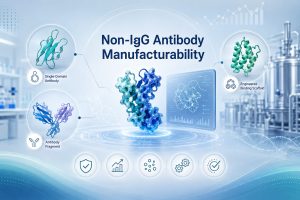
Non-IgG antibodies are gaining increasing attention in therapeutic discovery and biotechnological research because they offer structural flexibility, compact molecular size, modular design potential, and unique biological advantages that conventional IgG antibodies may not always provide. These molecules can include single-domain antibodies, antibody fragments, engineered scaffold-based binders, multispecific antibody formats, and other customized non-IgG constructs.
However, a promising non-IgG antibody is not defined by binding affinity alone. To move from discovery to practical application, the molecule must also be manufacturable. Manufacturability refers to whether a candidate can be expressed, purified, scaled, formulated, and controlled in a reliable and cost-effective way. For non-IgG antibodies, manufacturability can be especially challenging because many of these formats do not follow standard IgG production workflows.
Expression system selection and process design are two of the most important factors affecting non-IgG antibody manufacturability. A molecule that performs well in a screening assay may still face development barriers if it expresses poorly, aggregates during purification, requires complex refolding, or shows instability during scale-up. Therefore, manufacturability should be considered early in non-IgG antibody design rather than treated as a late-stage production issue.
Understanding Manufacturability in Non-IgG Antibody Development
Manufacturability describes the practical feasibility of producing a therapeutic or research-grade molecule with consistent quality. For non-IgG antibodies, manufacturability includes expression level, solubility, correct folding, stability, impurity profile, purification efficiency, and scalability.
Unlike full-length IgG antibodies, many non-IgG antibodies lack an Fc region. This means they may not be compatible with common Protein A-based purification platforms. They may also have different folding requirements, altered disulfide bond patterns, exposed hydrophobic regions, or linker-dependent structural behavior. These factors make early manufacturability assessment essential.
Why Manufacturability Should Be Considered Early
Early manufacturability assessment helps reduce downstream development risk. If a molecule has poor solubility, low expression, high aggregation tendency, or unstable domain architecture, these issues may become harder and more expensive to solve later.
By integrating manufacturability into early design, development teams can select candidates that combine biological function with production feasibility. This approach improves the chance that a non-IgG antibody can progress smoothly from discovery to process development and potential clinical manufacturing.
Key Manufacturability Questions for Non-IgG Antibodies
Several questions should be addressed during candidate selection:
Can the molecule be expressed at a useful level?
Does it fold correctly in the selected host system?
Is the product soluble and stable after expression?
Can it be purified without excessive product loss?
Does it require post-translational modification?
Is the process scalable and reproducible?
Can analytical methods confirm product identity, purity, and potency?
These questions help guide expression system selection, molecular engineering, upstream development, and downstream process design.
Choosing the Right Expression System for Non-IgG Antibodies
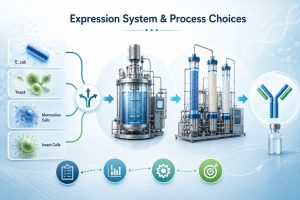
The expression system is a core factor in non-IgG antibody manufacturability. Different host systems provide different advantages in speed, cost, folding capacity, post-translational modification, secretion efficiency, and scalability. The best system depends on the structure and intended use of the antibody format.
Mammalian Expression Systems
Mammalian expression systems, such as CHO and HEK293 cells, are widely used when product quality, folding, and post-translational processing are important. These systems provide an intracellular environment that supports complex protein folding, disulfide bond formation, and secretion.
For non-IgG antibodies, mammalian expression can be useful for complex multispecific formats, Fc-fusion molecules, antibody fragments requiring precise folding, and constructs that may depend on mammalian-like post-translational modifications.
The advantage of mammalian systems is high product quality and strong regulatory familiarity. However, production costs may be higher than microbial systems, and development timelines may be longer. Some non-IgG antibodies may also show limited secretion or degradation in mammalian cell culture, requiring optimization of signal peptides, vector design, culture conditions, and clone selection.
E. coli Expression Systems
E. coli is often attractive for non-IgG antibody production because it is fast, cost-effective, and capable of high-yield fermentation. It is commonly used for antibody fragments, single-domain antibodies, scFvs, and other non-glycosylated formats.
The main benefit of E. coli is productivity. However, the main challenge is correct folding. The bacterial cytoplasm is a reducing environment, which can interfere with disulfide bond formation. Some non-IgG antibodies may accumulate as inclusion bodies, requiring denaturation and refolding. While inclusion body production can sometimes yield large amounts of product, refolding can complicate process scale-up.
To improve manufacturability in E. coli, developers may use periplasmic expression, engineered oxidative strains, solubility-enhancing fusion tags, lower induction temperatures, optimized codon usage, or co-expression of folding factors.
Yeast Expression Systems
Yeast systems, including Pichia pastoris and Saccharomyces cerevisiae, provide a balance between microbial productivity and eukaryotic folding capacity. Yeast can grow to high cell densities, secrete recombinant proteins, and support some post-translational processing.
For non-IgG antibodies, yeast expression may be useful for stable antibody fragments and single-domain antibodies that benefit from secretion but do not require fully human-like glycosylation.
Yeast systems can offer strong volumetric productivity, but challenges may include hyperglycosylation, proteolytic degradation, and secretion stress. Signal peptide screening, protease-deficient strains, pH control, temperature optimization, and fermentation strategy development can help improve yield and product quality.
Insect Cell Expression Systems
Insect cell systems, commonly based on baculovirus expression, can support eukaryotic folding and relatively rapid protein production. They are often used for research-stage production, structural biology, and complex recombinant proteins.
For non-IgG antibodies, insect cells may be useful when bacterial expression is insufficient and mammalian expression is not yet required. However, glycosylation patterns differ from mammalian cells, and infection-based production may introduce process variability. Therefore, insect expression is often valuable for early-stage evaluation rather than final large-scale manufacturing.
Designing Non-IgG Antibodies for Better Expression
Expression system selection should be combined with molecule-level design. A non-IgG antibody should be engineered not only for target binding but also for expression efficiency, folding, stability, and purification compatibility.
Codon Optimization
Codon optimization can improve translation efficiency in the chosen host system. However, optimization should be balanced. Excessive optimization may affect mRNA structure, translation speed, and co-translational folding. The goal is to support reliable protein expression without increasing misfolding risk.
Signal Peptide Selection
For secreted expression, the signal peptide can strongly influence production yield. Different signal sequences may result in different secretion efficiency, intracellular retention, or degradation levels. Screening multiple signal peptides can help identify the best secretion strategy for a specific non-IgG antibody format.
Linker Engineering
Many non-IgG antibodies use linkers to connect domains or functional modules. Linker length, flexibility, charge, and protease sensitivity can influence folding, binding, stability, and aggregation. Flexible glycine-serine linkers are common, but rigid or semi-rigid linkers may be better for certain domain orientations.
Disulfide Bond Optimization
Correct disulfide bond formation is critical for many antibody fragments and non-IgG formats. Mispaired disulfides can reduce activity and increase heterogeneity. Engineering strategies may include removing unnecessary cysteines, stabilizing domain interfaces, using host systems with oxidative folding capacity, or optimizing redox conditions during expression and purification.
Surface Charge and Hydrophobicity Control
Exposed hydrophobic patches can increase aggregation, while unfavorable charge distribution can reduce solubility or complicate purification. Sequence analysis and experimental screening can help identify problematic regions. Rational mutations may improve solubility and stability while preserving binding activity.
Upstream Process Choices That Affect Manufacturability
Upstream process development focuses on how the molecule is produced before purification. For non-IgG antibodies, upstream parameters can strongly affect yield, solubility, folding quality, and impurity profiles.
Culture Conditions and Induction Strategy
In microbial systems, induction temperature, inducer concentration, growth phase, oxygen transfer, and feeding strategy can influence expression quality. Lower temperatures may reduce total expression speed but improve solubility and folding.
In mammalian systems, medium composition, feeding strategy, temperature shift, culture duration, and harvest timing can affect both titer and product quality. Maintaining cell viability is important because cell lysis can increase host cell protein contamination and protease exposure.
Clone and Strain Selection
Clone or strain selection is critical for process robustness. A high-producing clone is not always the best manufacturing candidate if it produces heterogeneous or unstable product. The ideal production host should provide a balance of expression yield, product quality, genetic stability, and scalability.
Soluble Expression versus Total Expression
For non-IgG antibodies, total expression level alone can be misleading. A process that generates high levels of insoluble or misfolded protein may not be manufacturable. Soluble, correctly folded, and functional product yield is a more meaningful metric.
Downstream Process Design for Non-IgG Antibodies
Downstream processing is often more customized for non-IgG antibodies than for conventional IgGs. Since many non-IgG antibodies lack an Fc region, developers may need alternatives to standard Protein A purification.
Capture Strategy
Capture options may include affinity tags, antigen-specific affinity chromatography, ion exchange chromatography, mixed-mode chromatography, or customized ligand-based purification. Affinity tags can be useful during early-stage research, but therapeutic development may require tag removal or tag-free purification strategies.
Polishing and Aggregate Removal
Aggregation is a common concern in non-IgG antibody development. Polishing steps such as ion exchange chromatography, hydrophobic interaction chromatography, mixed-mode chromatography, or size-based separation may be used to remove aggregates, clipped products, host cell proteins, host cell DNA, endotoxin, and other process-related impurities.
Purification Scalability
A purification method that works at small scale may not be practical at manufacturing scale. Size-exclusion chromatography, for example, is useful for analytical or small-scale purification but may have limited scalability. A manufacturable downstream process should be efficient, reproducible, cost-effective, and compatible with larger production volumes.
Analytical Testing for Manufacturability Assessment
Analytical testing connects molecular design with process performance. It helps determine whether the expressed and purified non-IgG antibody has the required identity, purity, stability, and function.
Expression and Purity Analysis
SDS-PAGE, Western blot, HPLC, UPLC, and capillary electrophoresis can be used to evaluate expression, purity, molecular size, and product-related impurities.
Stability and Aggregation Testing
Thermal stability assays, dynamic light scattering, size-exclusion chromatography, and forced degradation studies can help assess aggregation risk and formulation behavior.
Functional Characterization
Binding assays, potency assays, and target engagement studies confirm that the production process preserves biological activity. This is especially important when process changes are introduced during optimization.
Integrating Developability and Manufacturability
Developability and manufacturability are closely linked. A non-IgG antibody with poor developability characteristics is often difficult to manufacture. Early developability studies can identify risks such as aggregation, low thermal stability, chemical degradation motifs, protease sensitivity, poor solubility, or unfavorable charge behavior.
Engineering for Improved Developability
If issues are identified early, engineering strategies can be used to improve the molecule. These may include sequence optimization, linker redesign, domain reorientation, removal of liability motifs, stabilization mutations, or surface charge modification. The goal is to preserve biological activity while improving expression, purification, and stability.
Balancing Function and Production Feasibility
Non-IgG antibody engineering often involves trade-offs. A modification that improves binding may reduce solubility. A linker that enhances flexibility may increase protease sensitivity. A format that improves potency may complicate expression. Successful development requires balancing functional performance with manufacturability.
Building a Scalable Strategy for Non-IgG Antibody Production
There is no universal expression system or process strategy for all non-IgG antibodies. The optimal approach depends on molecular format, quality requirements, production scale, timeline, cost, and regulatory expectations.
A small, stable, non-glycosylated single-domain antibody may be suitable for E. coli or yeast expression. A complex multispecific construct may require mammalian expression. An early research-stage molecule may first be evaluated in transient mammalian or insect cell expression before moving into a more scalable production platform.
The most effective strategy is to consider manufacturability from the beginning. By integrating expression system selection, molecular design, upstream optimization, downstream purification, and analytical testing, developers can reduce risk and improve the likelihood of scalable success.
Creative Biolabs Services for Non-IgG Antibody Development
Creative Biolabs offers integrated services to support non-IgG antibody development: