

Introduction: Moving Beyond the IgG-Centered Bioprocessing Model
For decades, antibody production has been largely shaped by the success of IgG monoclonal antibodies. Most expression platforms, purification workflows, analytical assays, and scale-up strategies were optimized around the IgG molecule: a relatively compact, Y-shaped immunoglobulin with well-established Protein A affinity purification and predictable manufacturing behavior. However, as antibody research expands into non-IgG isotypes, especially IgM and IgA, bioprocessing teams are increasingly facing a different set of rules.
IgM and IgA are not simply “IgG alternatives.” They have unique architectures, assembly pathways, biological functions, and purification requirements. These differences can create valuable opportunities in therapeutic development, mucosal immunity research, infectious disease studies, oncology, diagnostics, and immune mechanism exploration. At the same time, they introduce practical challenges in production, downstream processing, product characterization, stability control, and batch consistency.
Understanding why IgM and IgA behave differently in bioprocessing is essential before designing a production workflow. A process that works well for IgG may not preserve the correct multimeric form of IgM. A purification method that gives excellent IgG recovery may fail to capture IgA efficiently. A standard expression strategy may generate heterogeneous products if assembly, glycosylation, or chain pairing is not carefully managed.
This article explains the major structural and process-related reasons behind these differences and highlights key considerations for successful non-IgG antibody production.
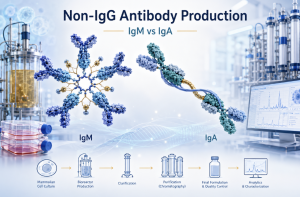
Why Non-IgG Antibody Production Requires a Different Mindset
Conventional IgG production benefits from a mature and highly standardized bioprocessing ecosystem. In many cases, the workflow is straightforward: select an expression system, optimize upstream culture, purify by Protein A affinity chromatography, polish using ion exchange or size exclusion chromatography, and confirm quality attributes.
IgM and IgA, however, demand a more customized approach. Their molecular size, degree of polymerization, glycosylation patterns, and assembly requirements can change how they behave during cell culture, clarification, chromatography, filtration, storage, and formulation.
In non-IgG antibody production, the central question is not only “How much antibody can be expressed?” but also “What form of the antibody is being produced?” For IgM, the desired product may be pentameric or hexameric. For IgA, the target format may be monomeric, dimeric, or secretory IgA. Each form has different biological relevance and different processing behavior.
This means that production and purification cannot be separated from structural biology. A high titer is not necessarily useful if the final product contains incomplete assemblies, aggregates, degraded fragments, or mixed oligomeric species. Therefore, successful bioprocessing must be designed around the intended antibody format from the beginning.
IgM: A Large, Multivalent Antibody with Complex Assembly Needs
IgM is often described as the largest immunoglobulin class. In its secreted form, it typically exists as a pentamer, and in some cases as a hexamer. This multimeric structure gives IgM high avidity and strong potential for antigen clustering and complement activation. These biological advantages are also the reason IgM is increasingly explored in therapeutic and diagnostic contexts.
From a production perspective, however, the same structure creates challenges. IgM is not a small, simple antibody molecule. It is a large macromolecular complex composed of multiple monomeric units connected through disulfide bonds and, in pentameric forms, usually associated with the J chain. Correct assembly depends on the coordinated expression of heavy chains, light chains, and accessory components, as well as proper intracellular folding and secretion.
If the expression system is not optimized, IgM production may result in incomplete multimers, mispaired chains, intracellular retention, low secretion efficiency, or increased aggregation. The cell line must support proper disulfide bond formation and secretory pathway handling of a large polymeric antibody. CHO, HEK293, PER.C6, myeloma, and other mammalian systems may be selected depending on the project goal, expression scale, species origin, and downstream requirements.
Because of its size, IgM can also behave differently during physical processing. Shear stress, inappropriate buffer conditions, long processing times, or harsh purification steps may affect structural integrity. The process must protect both purity and functional multimeric architecture.
Why IgM Purification Is More Challenging Than IgG Purification
A major reason IgM bioprocessing differs from IgG bioprocessing is the limited usefulness of standard Protein A/G workflows. Protein A affinity chromatography is central to many IgG production pipelines, but it is not a universal solution for IgM. IgM’s Fc architecture and large polymeric structure require alternative capture and polishing strategies.
Common IgM purification approaches may include ceramic hydroxyapatite enrichment, PEG precipitation, ion exchange chromatography, size exclusion-based methods, and specialized affinity ligands targeting IgM-specific regions. The right strategy depends on the sample source, expression system, product form, impurity profile, target purity, and recovery requirement.
For example, hybridoma supernatants may contain serum proteins, host cell proteins, DNA, media components, and other contaminants that require a different capture approach than recombinant serum-free expression supernatants. Large-scale IgM production may require a workflow that balances purity, recovery, scalability, and preservation of functional activity. Size-based methods can help separate large multimeric IgM from smaller impurities, but they may also need careful optimization to avoid dilution, low throughput, or product loss.
Another key issue is heterogeneity. IgM products may contain different oligomeric species or assembly intermediates. Downstream analytics should therefore evaluate not only concentration and purity, but also molecular size distribution, aggregation, intactness, binding activity, and functional performance.
IgA: A Flexible Isotype with Multiple Bioprocessing Identities
IgA presents a different set of bioprocessing questions. Unlike IgM, IgA is not usually defined by a single dominant production format. It may be produced as monomeric IgA, dimeric IgA, or secretory IgA, depending on the biological purpose and intended application.
Monomeric IgA is commonly associated with serum, while dimeric and secretory forms are especially relevant to mucosal immunity. Secretory IgA includes additional structural components that support its stability and function at mucosal surfaces. These features make IgA attractive for studies involving respiratory, gastrointestinal, urogenital, and other mucosal systems.
However, the ability to exist in several forms also complicates production. A project must define the desired IgA format early. Producing monomeric IgA may require one strategy, while producing dimeric or secretory IgA may require co-expression of additional chains or components. Subclass selection, such as IgA1 or IgA2, can also influence hinge structure, protease sensitivity, expression behavior, and downstream properties.
IgA is therefore a “format-sensitive” antibody. Its production process must match the biological question being asked. If the goal is to study mucosal immune exclusion, dimeric or secretory IgA may be more relevant. If the goal is receptor-mediated effector function or comparison with IgG-like formats, monomeric IgA may be suitable. The upstream process, purification strategy, and quality control plan should all be aligned with this format decision.
Expression Considerations for IgA Production
IgA production starts with selecting an expression strategy capable of generating the correct antibody form at acceptable yield and quality. Mammalian expression systems are commonly used because they support complex folding, glycosylation, secretion, and assembly. Depending on project requirements, recombinant expression, hybridoma-based approaches, or antibody isotype switching strategies may be considered.
For monomeric IgA, the process may resemble standard recombinant antibody expression more closely than IgM production, although purification and stability behavior still differ from IgG. For dimeric or secretory IgA, the process becomes more complex. Additional components, such as J chain and secretory component-related elements, may need to be incorporated. Expression ratios, vector design, transfection conditions, and clone screening can all influence final product composition.
Glycosylation is another important factor. IgA contains glycan structures that can affect solubility, receptor binding, stability, and immune interactions. Therefore, cell line selection and culture conditions may influence not only yield but also product quality. During process development, analytics should be used to monitor molecular form, glycosylation profile, aggregation, purity, and antigen-binding performance.
IgA Purification: Selectivity Matters
IgA purification can also differ significantly from IgG purification. While certain Protein A/G/L-based methods may be useful in specific contexts, IgA often requires more tailored purification strategies. Depending on the subclass, format, and expression source, lectin chromatography, ion exchange chromatography, peptide-based affinity methods, size-based purification, or combined workflows may be used.
The key challenge is selectivity. IgA may exist as different molecular forms, and the purification method must enrich the desired form while removing host cell proteins, DNA, aggregates, fragments, and incorrectly assembled species. For dimeric or secretory IgA, size and structural integrity become especially important.
Purification conditions must also avoid destabilizing the molecule. pH, salt concentration, elution conditions, buffer exchange, and concentration steps should be optimized to preserve binding and functional activity. In some cases, a gentle but multi-step workflow may be preferable to an aggressive single-step process if it improves product quality and consistency.
Key Differences Between IgM and IgA in Bioprocessing
Although IgM and IgA are both non-IgG antibodies, they should not be treated as the same type of production challenge.
IgM is primarily challenging because of its very large polymeric structure, complex assembly, high molecular weight, and incompatibility with routine IgG purification assumptions. Its production workflow must focus on multimer integrity, correct J-chain-related assembly when relevant, and preservation of avidity-driven function.
IgA is challenging because of its format diversity. It may be monomeric, dimeric, or secretory, and each form has different expression and purification requirements. IgA production must be designed around the intended biological role, especially when mucosal function is important.
In simple terms, IgM bioprocessing is often an assembly-and-size challenge, while IgA bioprocessing is often a format-and-selectivity challenge. Both require careful upstream design, customized downstream purification, and strong analytical support.
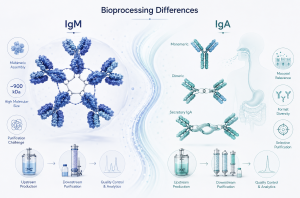
Analytical Control Is Essential for Non-IgG Antibody Production
For IgG antibodies, purity and concentration are important, but many standard assays are already well established. For IgM and IgA, analytical control becomes even more critical because product heterogeneity can directly affect function.
Important analytical considerations include:
- Molecular weight and oligomeric state
- Purity and impurity profile
- Aggregation level
- Heavy-chain and light-chain integrity
- J-chain or accessory component incorporation, when applicable
- Binding activity
- Functional activity, such as receptor interaction or complement-related effects
- Glycosylation characteristics
- Stability under storage and handling conditions
These assays help determine whether the production process has generated the intended antibody product, rather than simply producing an immunoglobulin-like protein. In non-IgG antibody bioprocessing, “correct form” and “correct function” must be evaluated together.
Process Development Strategies for Better IgM and IgA Outcomes
A successful non-IgG antibody production project usually begins with a clear product definition. Before starting expression, teams should define the target isotype, subclass, oligomeric form, sequence design, accessory chain requirements, expected application, purity goal, scale, and downstream testing needs.
For IgM, early process development may include testing expression systems for secretion efficiency and assembly quality. Culture conditions should be optimized to reduce stress and support proper folding. Purification screening should focus on methods that can handle large molecules without compromising recovery or structural integrity.
For IgA, early development should clarify whether the desired product is monomeric, dimeric, or secretory. The expression strategy should be designed accordingly. Purification screening should compare selectivity for the target form and ability to remove closely related impurities or assembly variants.
In both cases, small-scale feasibility studies can reduce risk before scale-up. Rather than applying a standard IgG workflow and troubleshooting later, it is more efficient to build the process around the antibody’s structural behavior from the beginning.
Why These Differences Matter for Research and Therapeutic Development
The growing interest in IgM and IgA is driven by biology. IgM’s multivalency can support strong avidity, antigen clustering, and complement-related mechanisms. IgA’s role at mucosal surfaces and its interaction with specific immune receptors make it attractive for applications where IgG may not be optimal.
However, these biological strengths can only be realized if production and purification preserve the right molecular form. A poorly assembled IgM may lose the functional benefit of multivalency. An IgA product with mixed forms may give inconsistent results in receptor-binding or mucosal immunity studies. A process that maximizes yield but sacrifices quality may not support downstream research or preclinical development.
Therefore, non-IgG antibody production should be viewed as a specialized bioprocessing discipline. It requires knowledge of antibody biology, expression systems, purification science, and analytical characterization. IgM and IgA can behave “differently” because they are structurally and functionally different—and the process must respect those differences.
Conclusion: Non-IgG Antibody Bioprocessing Should Be Built Around the Molecule
IgM and IgA expand the possibilities of antibody research beyond the traditional IgG framework. They offer unique biological functions, but they also require specialized production and purification strategies. IgM demands attention to polymeric assembly, molecular size, and structural integrity. IgA requires careful control of format, subclass, purification selectivity, and mucosal-relevant forms.
For researchers developing non-IgG antibodies, the most important step is to avoid forcing IgM or IgA into an IgG-style workflow. Instead, production and bioprocessing should be designed around the molecule’s natural architecture, desired function, and final application. With a tailored strategy, IgM and IgA antibodies can be produced with improved quality, consistency, and biological relevance.
Related Creative Biolabs Services and Products
Creative Biolabs provides customized support for non-IgG antibody production, purification, and related product needs: